
The Gender Equality Index 2025 compiled by the European Institute for Gender Equality, an EU agency headquartered in Vilnius, Lithuania, reports that while gender equality in the EU is slowly improving, major areas of inequality remain affecting all aspects of women’s lives, including the workplace and financial wellbeing.
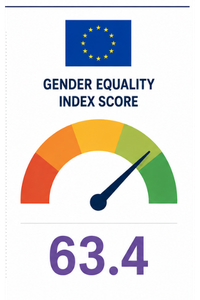
The overall Gender Equality Index score for the EU for 2025 was 63.4, with 100 representing complete equality. Although the index figure has risen from 52.9 in 2010 and 56.0 in 2015, at the current rate full gender equality will take at least another 50 years to achieve.
The index finds that women in the EU remain more financially insecure. On average, women earn just 77% of men’s annual income. Within couples, they earn 30% less than their partners, reinforcing financial dependence at home.
Launched in 2013, the Gender Equality Index is designed to help EU policymakers track progress and tackle ongoing obstacles to gender equality. The annual index summarises the multidimensional nature of gender equality and provides a comprehensive but also nuanced picture of where inequalities persist and how they are evolving.
The index tracks six essential dimensions from people’s everyday lives – work, money, knowledge, time, power and health – as well as two further domains that cut across all areas: violence and intersecting inequalities.
Money: lower earnings, pension gap and traditional attitudes
The Gender Equality Index score for money was 73.9. Although gender equality in financial resources is steadily improving, women in the EU still earn just 77% of men’s annual earnings, up from 69% in 2015. The financial impact of lower pay, part-time work and career breaks due to caregiving responsibilities accumulates over a lifetime, resulting in a substantial gender pension gap and a higher risk of poverty in older age.
Within couples, women earn on average 30% less than their partners, reinforcing financial dependence at home, where men tend to maintain strategic control over household finances. Attitudes continue to reinforce the gap: in 2024, 39% of women and 45% of men in the EU still believed a man’s most important role was to earn money. Fewer young people aged between 15 and 24 agreed, but a still significant 30% of women and 43% of men.
One-third of women and 42% of men among EU citizens aged between 16 and 74 agreed that if childcare services were not available, mothers should stay at home with their children while fathers should prioritise working.
Work: glass ceiling, care burden and low-paid careers
For work, the EU Gender Equality Index score was 69.3. More women have joined the workforce in the past 10 years, but their access to managerial, information technology and other better-paid career paths remains limited.
Living together as a couple with children boosts men’s work prospects but constrains women’s, reflecting the impact of gender stereotypes on economic opportunities. Women continue to shoulder most unpaid and intense care provision, limiting their engagement in leisure and public life.
Women remain concentrated in sectors and jobs with lower pay and less perceived value – but, even here, men dominate the highest positions. Only two in ten IT specialists in the EU are women. Overall, 35% of managers in the EU are women, an increase of just three percentage points since 2015.
Far more young women than men complete tertiary education, but because they are steered into disciplines traditionally perceived as ‘feminine’, their academic success does not translate into equal opportunities at work or in leadership, nor into equal pay and pensions.
Across age groups, men consistently believe they earn more than women because their jobs are more demanding – a perception shared much less by women, particularly young women.
Employment central to independence
One of the most effective ways policies can support women’s financial independence, the data reveal, is by promoting and enabling their employment.
Research has demonstrated that the labour market participation of women who are part of couples is more sensitive to financial incentives or disincentives than that of men in couples; women are more likely than men to reduce their working hours or leave the workforce if the tax burden increases or care provision diminishes.
The conclusion: unlocking women’s full potential means tackling occupational segregation, ensuring access to high-quality jobs with decent conditions and remuneration, and creating equal career prospects – all critical steps to strengthening competitiveness, innovation and social cohesion within the EU.
Other VitalBriefing stories you might be interested in:

Gender Finance: Women’s crucial role in the future of Europe’s investment market
Wealth is on the move, with trillions of dollars’ worth of assets set to shift from the Baby Boomer generation of the post-World War II years into new hands over the coming years. And while this handover, dubbed the Great Wealth Transfer, represents a significant shift of economic resources, more importantly, it will hand women…

Why recycling is becoming a prime sector for investment
How much do you know about investing in the recycling sector? Not as much as you may think, we’ll bet. So we spoke to Kai Curry-Lindahl, a fund manager and recycling expert at Active Niche Funds, who explained that the industry is in a major phase of innovation and a prime target for investment — if you…

The price we pay for biodiversity loss
It’s more important than ever before to contextualise our planet’s biodiversity loss, especially at a corporate level.

Are sustainability standards converging in the finance sector?
With a variety of initiatives aiming to harmonise sustainability standards and definitions globally, how can finance professionals comply to the range of divergent and perhaps conflicting rulebooks?